When the European Union Artificial Intelligence Act (EU AI Act) was officially enacted, many business leaders outside of Europe breathed a sigh of relief, assuming the regulation was a localized issue for companies with physical offices in Paris, Munich, or Brussels.
This is a dangerous, multi-million-dollar misconception.
The EU AI Act is designed with strong extraterritorial jurisdiction. Under Article 2, the Act applies to any provider placing AI systems or General-Purpose AI (GPAI) models on the market in the EU, or putting them into service in the EU, regardless of whether they are established inside the Union or in a third country.
If you are a US-based SaaS company, a UK financial tech platform, or an Asian business automation provider, and European businesses use your software, you are legally bound by the EU AI Act.
However, this regulatory expansion represents a massive market opportunity. For global software builders, compliance engineers, and consulting firms located outside the EU, enabling compliance isn’t just a necessity—it is a premium, high-value service offering that unlocks access to the world’s largest single market.
1. The Compliance Gap for Non-EU AI Providers
When a software company based outside the EU attempts to distribute AI-driven products within Europe, they face immediate structural hurdles. The law holds them to the exact same standards as domestic European firms, but adds a critical layer of co-liability.
Under Article 25, any non-EU provider of a high-risk AI system must appoint an Authorized Representative established in the Union prior to making their system available on the market.
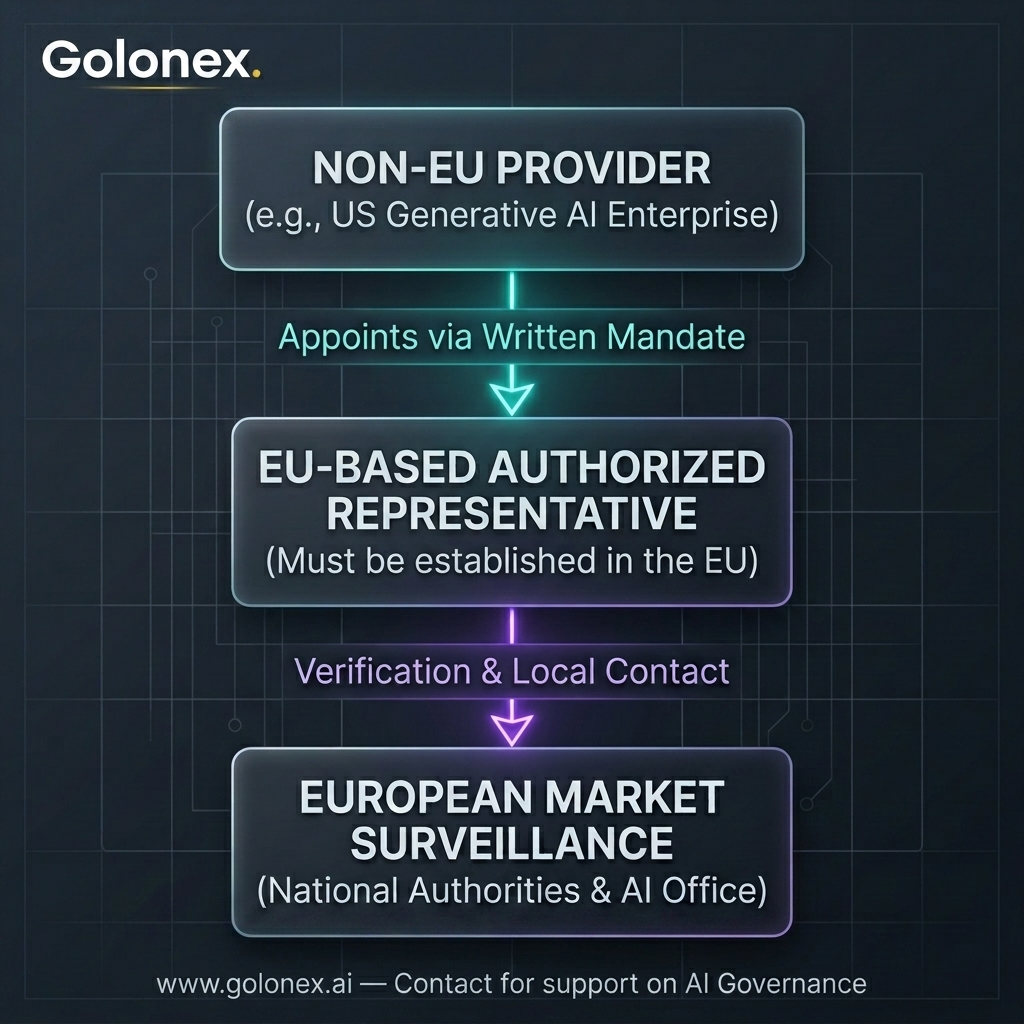
This Authorized Representative acts as the local regulatory proxy, keeping technical files ready for audit and standing co-liable for compliance failures. For non-EU companies, finding, establishing, and legally structuring these relationships is a complex barrier to entry. This is where specialized, cross-border compliance enablement becomes invaluable.
2. Five Ways Non-EU Companies Can Lead AI Act Enablement
As a global technology developer or advisory firm located outside the EU, you can act as a compliance gateway, helping other international firms engineer and audit their way into the European market.
Here are the five core pillars where non-EU companies can build premium service lines to enable compliance:
2.1 Boundary & Classification Auditing
Before spending hundreds of thousands of dollars on conformity assessments, companies need to know where they stand. Non-EU advisors can perform Article 6 Boundary Audits to classify systems into the four risk tiers:
- Unacceptable Risk: Helping companies identify and pivot away from banned use cases (such as emotion recognition in the workplace or untargeted facial scraping) before hitting legal blocks.
- High-Risk: Auditing Annex III categories (e.g., credit scoring, employment algorithms) to establish readiness paths.
- Limited/Minimal Risk: Helping clients successfully document and leverage the Article 6(3) Derogation (the narrow procedural exception) to avoid unnecessary compliance costs.
2.2 UI/UX Human Oversight Engineering (Article 14)
The EU AI Act mandates that high-risk systems must be designed in a way that allows them to be effectively overseen, controlled, and overridden by human operators. This is an engineering and design challenge. Non-EU product teams can design the interfaces, warning systems, and real-time telemetry that give humans an "emergency brake" over AI decisions. Building these controls natively into the product architecture makes the software instantly attractive to risk-averse European enterprise buyers.
2.3 Automated Event Logging & Security (Article 12)
High-risk AI systems must automatically log events throughout their lifecycle to guarantee traceability. Compliance enablers can build secure, private, and tamper-evident logging layers (using secure ledger technology or robust cloud enclaves) that track:
- System startup and shutdown times.
- Input data vectors and output decisions.
- Warning flags and override actions taken by human operators.
2.4 Quality Management System (QMS) Construction (Article 17)
Every high-risk provider must implement a robust QMS that covers post-market monitoring, data governance, and risk management. External compliance enablers can build, implement, and audit these GRC frameworks for engineering teams, preparing them for formal conformity audits.
2.5 Technical Documentation & Annex IV Assembly
compiling the exhaustive technical paper trail required under Article 11 and Annex IV is a highly technical task. Enablement teams can bridge the gap between engineering and law by translating raw model architectures, training datasets, and testing parameters into clean, audit-ready compliance dossiers.
3. Turning Compliance into a B2B Growth Engine
Far too many enterprises view the EU AI Act as a bureaucratic brake on innovation. In reality, robust governance is an operational speed booster.
When a non-EU company proactively designs its AI systems to meet EU standards:
- Accelerated Procurement: They bypass long, exhausting security and legal reviews when selling into European enterprise companies.
- Global Brand Trust: EU compliance is rapidly becoming the gold standard for global AI safety, much like GDPR became the benchmark for data privacy. Proving compliance in Europe signals elite trustworthiness to clients in the US, UK, and Asia.
- Future-Proof Products: As other countries (like the US or Canada) introduce their own AI frameworks, products built under the rigid guidelines of the EU AI Act are already 90% prepared for any global regulatory shift.
4. How Golonex Helps You Bridge the Border
At Golonex, we don't just advise on the law—we engineer the software controls that satisfy it. Operating globally, our AI Compliance & GRC engineering practice specializes in helping international enterprises build the private enclaves, automated logging schemas, and human oversight telemetry required to safely scale into the European Union.
We help you turn complex Article 3 statutory definitions into clean, high-performance code, ensuring your software is fully compliant before your compliance clock starts ticking.
To audit your systems or build your extraterritorial compliance gateway, connect with our GRC engineering team at golonex.ai.